Why Endotoxin Results Vary Between Analysts
A common question in pharmaceutical, biotechnology, and medical device laboratories is:
“Why does Analyst A consistently obtain different endotoxin results from Analyst B when using the same method?”
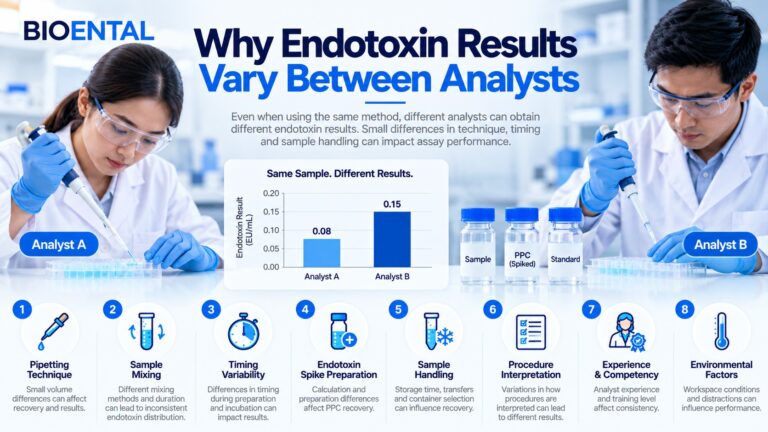
While endotoxin testing methods are validated and highly controlled, analyst-related variability can still influence assay performance. Small differences in technique, timing, sample handling, and procedural execution can affect Product Positive Control (PPC) recovery, endotoxin recovery, and overall test reliability.
Understanding these sources of variability can help laboratories improve consistency, reduce investigations, and strengthen confidence in bacterial endotoxin testing (BET) results.
Should Different Analysts Get the Same Results?
In theory, yes.
When a method is properly validated and analysts are adequately trained, results should fall within an acceptable range of variation.
However, endotoxin assays are highly sensitive biological reactions. Even minor procedural differences can influence the outcome.
This does not necessarily mean one analyst is wrong. Instead, it may indicate variability within the testing process that should be understood and controlled.
1. Pipetting Technique Differences
Pipetting is one of the most common causes of analyst-to-analyst variation.
Small inaccuracies can significantly affect:
- PPC recovery
- Endotoxin spike concentration
- Standard preparation
- Sample dilution accuracy
Examples include:
- Inconsistent aspiration speed
- Incorrect pipette angle
- Incomplete dispensing
- Failure to pre-wet tips
- Using an inappropriate pipette range
Even a small volume difference can affect recovery calculations.
Best Practice
- Perform routine pipette calibration.
- Conduct practical pipetting assessments.
- Standardize pipetting techniques across analysts.
2. Differences in Sample Mixing
Proper mixing is essential for uniform endotoxin distribution.
Variations may occur when analysts:
- Mix for different durations
- Use different mixing methods
- Shake more aggressively
- Mix insufficiently
Poor mixing can result in inconsistent endotoxin concentrations throughout the sample.
Best Practice
Create a standardized mixing procedure and include it in the testing SOP.
3. Timing Variability
Endotoxin testing often involves multiple timed steps.
Differences in timing can affect:
- Reagent exposure
- Sample preparation
- Incubation consistency
- Endotoxin spike stability
For example, one analyst may prepare and test immediately, while another may allow samples to sit for an extended period.
Best Practice
Define acceptable timing windows for critical steps.
4. Differences in Endotoxin Spike Preparation
Product Positive Controls rely on accurate spike preparation.
Variability may occur due to:
- Dilution calculation errors
- Incomplete mixing
- Different preparation techniques
- Pipetting inconsistencies
This can directly influence recovery performance.
Best Practice
Use standardized worksheets and independent verification of calculations.
5. Sample Handling Practices
Analysts may unknowingly introduce variability during sample handling.
Examples include:
- Number of sample transfers
- Container selection
- Storage duration before testing
- Exposure to environmental conditions
Additional handling steps may increase endotoxin adsorption and recovery variability.
Best Practice
Minimize sample handling and follow validated procedures.
6. Interpretation of Procedures
Sometimes variability occurs because different analysts interpret the same procedure differently.
Common examples include:
- Mixing intensity
- Waiting times
- Acceptance of questionable data
- Handling atypical samples
Even well-written SOPs may leave room for interpretation.
Best Practice
Review procedures regularly and clarify ambiguous instructions.
7. Experience and Competency Levels
Analyst experience often affects consistency.
Experienced analysts may:
- Recognize potential issues earlier
- Follow procedures more consistently
- Troubleshoot effectively
Newer analysts may require additional supervision and coaching.
Best Practice
Implement competency assessments and ongoing training programs.
8. Environmental Factors
Analysts working under different conditions may produce different results.
Examples include:
- Workspace organization
- Temperature fluctuations
- Distractions
- Workload pressure
Although these factors are often overlooked, they can influence execution quality.
Best Practice
Maintain controlled testing environments and minimize interruptions.
9. Variability During Method Suitability Testing
Method suitability studies often reveal analyst-related variability because they involve multiple preparation and dilution steps.
Differences may appear in:
- PPC recovery
- Dilution selection
- Spike preparation
- Sample preparation
Consistent method suitability procedures are essential for reliable results.
10. Inconsistent Documentation Practices
Variability is sometimes discovered only because documentation differs between analysts.
Incomplete records can make investigations more difficult and mask the true source of variation.
Best Practice
Require complete and standardized documentation for every test.
Signs Analyst Variability May Be Affecting Results
Consider investigating analyst-related factors if you observe:
✓ Consistent differences between analysts
✓ Variable PPC recovery results
✓ Recovery fluctuations without product changes
✓ Repeated retesting by specific analysts
✓ Differences during method suitability studies
✓ Increased investigation frequency
How Laboratories Can Reduce Analyst Variability
Successful laboratories focus on standardization.
Key measures include:
Standardized Procedures
Ensure SOPs clearly define every critical step.
Competency Assessments
Evaluate analysts regularly using practical demonstrations.
Routine Training
Provide refresher training and procedural updates.
Observation Programs
Periodically observe testing practices to identify procedural drift.
Trending Analysis
Review recovery trends by analyst to identify recurring patterns.
Equipment Verification
Confirm that all analysts use calibrated equipment consistently.
What Auditors Expect
During inspections, auditors may ask:
- How are analysts trained?
- How is competency assessed?
- How is analyst variability monitored?
- Are recovery trends reviewed?
- How are deviations investigated?
Being able to demonstrate a structured approach to analyst qualification helps strengthen confidence in the testing program.
Conclusion
Endotoxin testing is highly dependent on procedural consistency. Even when using the same method, differences in pipetting, mixing, timing, sample handling, interpretation, and experience can contribute to analyst-to-analyst variability.
By standardizing procedures, strengthening training programs, monitoring trends, and investigating variability proactively, laboratories can improve endotoxin testing consistency and reduce unnecessary investigations.
BIOENTAL supports pharmaceutical, biotechnology, medical device, and healthcare laboratories with endotoxin method suitability studies, analyst training support, troubleshooting assistance, recombinant endotoxin technologies, and endotoxin-free consumables to help improve BET reliability and consistency.