How to Troubleshoot an Endotoxin Test Failure: Common Problems and Solutions
Practical Solutions for Failed Recovery, PPC Failures, Inhibition, Enhancement and Out-of-Specification Results
Endotoxin testing failures can delay product release, increase laboratory workload and trigger costly investigations. This guide explains common causes of endotoxin testing problems and provides practical troubleshooting approaches for QC, microbiology and validation laboratories.
Why Endotoxin Tests Fail
Most endotoxin testing issues arise from one of five root causes:
Common Root Causes:
| Root Cause | Typical Symptoms |
|---|---|
| Contamination | Positive blank results |
| Inhibition | Low spike recovery |
| Enhancement | High spike recovery |
| pH Issues | Unpredictable results |
| Consumable Issues | Inconsistent results |
Troubleshooting Decision Tree
Unexpected Result
↓
Positive Blank?
↓
Yes → Check contamination
↓
No
↓
Failed Spike Recovery?
↓
Yes → Check inhibition
↓
No
↓
Recovery Too High?
↓
Yes → Check enhancement
↓
No
↓
Review method suitability
Problem #1 – Positive Blank Results
Symptoms
- Negative control becomes positive
- Endotoxin detected where none expected
- Sporadic positive results
Common Causes
- Contaminated water
- Contaminated pipette tips
- Contaminated tubes
- Environmental contamination
- Poor aseptic handling
Troubleshooting Steps
- Replace BET water.
- Use fresh endotoxin-free consumables.
- Review handling procedures.
- Test individual components separately.
- Check laboratory environment.
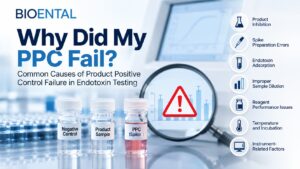
Problem #2 – Failed Positive Product Control (PPC)
Symptoms
Spike recovery below acceptance criteria.
Common Causes
- Product inhibition
- Incorrect dilution
- pH interference
- Chemical interference
Troubleshooting Steps
- Increase sample dilution.
- Check pH.
- Verify reagent preparation.
- Repeat Method Suitability Testing.
- Investigate matrix interference.
Problem #3 – Low Spike Recovery
Typical Causes
| Cause | Explanation |
|---|---|
| Product Matrix | Interferes with LAL reaction |
| Low pH | Inhibits enzymatic activity |
| Chelating Agents | Affect reaction cascade |
| Surfactants | Interfere with assay chemistry |
Recommended Actions
- Dilution studies
- Buffer optimisation
- Method suitability review
Problem #4 – High Spike Recovery
Typical Causes
| Cause | Explanation |
|---|---|
| β-Glucan Interference | False positive response |
| Sample Enhancement | Artificial signal increase |
| Contamination | External endotoxin source |
Recommended Actions
- Evaluate β-glucan blocker.
- Review sample composition.
- Verify consumables.
Problem #5 – Out-of-Specification (OOS) Results
Investigation Checklist
□ Confirm calculations
□ Verify standard curve
□ Review raw data
□ Check equipment calibration
□ Verify reagent expiry
□ Review analyst handling
□ Review environmental conditions
□ Assess contamination sources
Common Consumable-Related Issues
Why Consumables Matter
Endotoxin-free consumables help minimise contamination risks and improve result consistency.
Examples
| Consumable | Potential Risk |
|---|---|
| Pipette Tips | Endotoxin contamination |
| Water | False positives |
| Tubes | Background endotoxin |
| Bottles | Sample contamination |
| Microplates | Assay interference |
Troubleshooting Reference Table
Quick Diagnostic Guide
| Observation | Likely Cause | Recommended Action |
|---|---|---|
| Positive Blank | Contamination | Replace consumables |
| Low Recovery | Inhibition | Increase dilution |
| High Recovery | Enhancement | Investigate matrix |
| Variable Results | Handling error | Review SOP |
| Unexpected OOS | Multiple causes | Full investigation |
Frequently Asked Questions
What causes PPC failure in endotoxin testing?
PPC failure is commonly caused by product inhibition, pH interference or matrix effects affecting endotoxin recovery.
What is acceptable spike recovery?
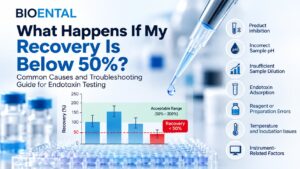
Most pharmacopeial requirements accept recovery between 50% and 200%.
Why are endotoxin-free consumables important?
Consumables may introduce endotoxin contamination that can affect assay accuracy and reproducibility.
Can dilution overcome inhibition?
In many cases, appropriate dilution can reduce matrix interference and improve recovery.
What should I do if my negative control is positive?
Investigate contamination sources including water, consumables, reagents and laboratory environment.
Ask BIOENTAL
My endotoxin recovery keeps failing. What should I check first?
Can β-glucan cause false positive endotoxin results?
Why did my endotoxin test pass last week but fail today?
How do I investigate a positive blank result?
When should I repeat Method Suitability Testing?
Need Help Investigating an Endotoxin Testing Issue?
BIOENTAL provides technical support for:
- Failed recovery investigations
- Method suitability testing
- Inhibition and enhancement studies
- Endotoxin-free consumable selection
- Validation support
Continue Learning
Recommended guides, troubleshooting resources, and validation insights for pharmaceutical, biotechnology, and medical device laboratories.