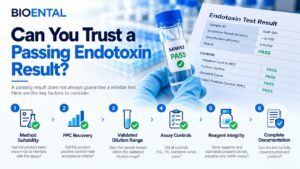
Can You Trust a Passing Endotoxin Result?
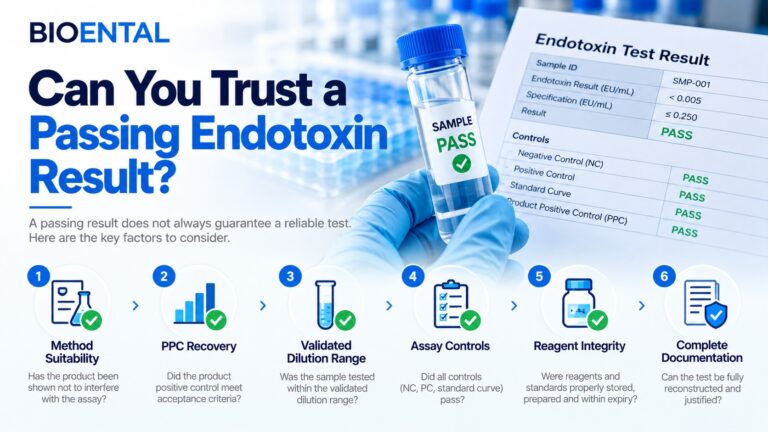
A passing endotoxin test result is often viewed as confirmation that a product meets its endotoxin specification. However, a passing result alone does not necessarily guarantee that the test was reliable, valid, or capable of detecting endotoxin accurately within the sample matrix.
To trust a passing result, laboratories must demonstrate that the test system was functioning correctly, the product did not interfere with detection, and all assay controls met acceptance criteria.
Understanding the difference between a passing result and a valid result is critical for maintaining product quality and regulatory compliance.
A Passing Result Is Only One Part of the Story
Many laboratories focus on the final endotoxin value:
Result: Pass
However, auditors, regulators, and quality professionals often ask a different question:
Can the result be trusted?
A passing result should only be accepted when:
- The assay controls passed
- Method suitability was demonstrated
- Recovery criteria were met
- Reagents performed as expected
- The test was conducted according to validated procedures
Without these elements, a passing result may not accurately reflect the true endotoxin status of the product.
What Makes an Endotoxin Result Trustworthy?
A reliable endotoxin result depends on several factors working together.
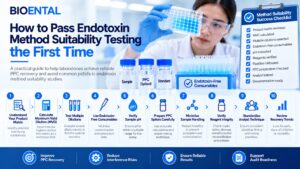
1. Method Suitability Was Successfully Demonstrated
Method suitability testing confirms that the product matrix does not interfere with endotoxin detection.
If a product inhibits the assay, endotoxin may be present but remain undetected.
A passing result obtained without successful method suitability testing may therefore be misleading.
Questions to Ask
- Was method suitability performed?
- Was recovery within acceptance criteria?
- Was the selected dilution validated?
- Were inhibitory effects investigated?
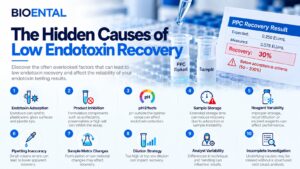
2. Product Positive Control (PPC) Recovery Passed
The PPC verifies that endotoxin can be detected in the presence of the product.
This is one of the most important indicators of result reliability.
A passing sample result accompanied by a failed PPC should raise concerns because the assay may not be functioning correctly within the product matrix.
Questions to Ask
- Did PPC recovery meet acceptance criteria?
- Was recovery between validated limits?
- Were any recovery trends observed?
3. The Sample Was Tested Within the Validated Dilution Range
Excessive dilution can sometimes reduce endotoxin concentrations below detectable levels.
Insufficient dilution may leave inhibitory substances present.
Both situations can affect confidence in the final result.
The dilution strategy should be supported by:
- Method suitability data
- Maximum Valid Dilution (MVD) calculations
- Validation documentation
4. The Assay Controls Were Valid
Every endotoxin test includes controls that help verify assay performance.
Typical controls include:
- Negative Controls
- Positive Controls
- Standard Curves
- Product Positive Controls
If any critical control fails, confidence in the reported result decreases significantly.
Questions to Ask
- Were all controls within specification?
- Was the standard curve valid?
- Were there any unexplained outliers?
5. Reagents and Standards Were Properly Managed
Even a passing result can be questionable if reagent integrity cannot be demonstrated.
Laboratories should verify:
- Expiration dates
- Storage conditions
- Reconstitution procedures
- Lot traceability
Improper reagent management can compromise assay performance without obvious warning signs.
When a Passing Result May Not Be Reliable
Several situations should trigger additional review.
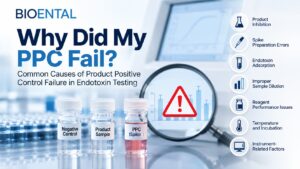
Scenario 1: PPC Recovery Failure
The sample passes, but PPC recovery fails.
Potential concern:
The product may be inhibiting endotoxin detection, creating a false-negative result.
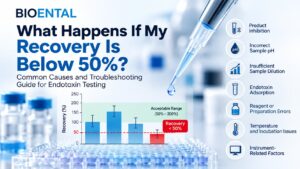
Scenario 2: Recovery Below Acceptance Criteria
The sample passes, but recovery falls below the validated acceptance range.
Potential concern:
The assay may not be capable of accurately detecting endotoxin in the product matrix.
Scenario 3: Method Suitability Was Never Performed
The sample passes, but no evidence exists that the method is suitable for the product.
Potential concern:
There is no documented proof that the assay can detect endotoxin reliably within the sample.
Scenario 4: Unexplained Control Failures
The sample passes, but controls show abnormalities or inconsistencies.
Potential concern:
The assay may not have performed as intended.
What Do Auditors Look For?
During GMP inspections, auditors rarely focus only on the final result.
Instead, they evaluate whether the laboratory can demonstrate that the result is scientifically valid.
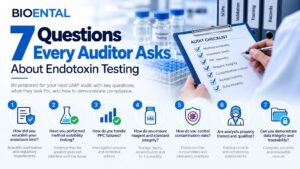
Common audit questions include:
- How was method suitability established?
- Were PPC acceptance criteria met?
- How are failures investigated?
- How is reagent integrity maintained?
- Can the test be fully reconstructed from the records?
A passing result supported by robust documentation is far more defensible than a passing result alone.
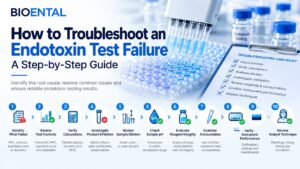
A Simple Reliability Checklist
Before accepting a passing endotoxin result, confirm:
✓ Method suitability completed
✓ PPC recovery passed
✓ Recovery met acceptance criteria
✓ All controls passed
✓ Dilution within validated range
✓ Reagents within expiry
✓ Equipment properly calibrated
✓ Documentation complete
✓ No unresolved deviations
✓ Results reviewed and approved
The more boxes checked, the greater confidence you can have in the reported result.
Common Misconception: “Pass Means Safe”
One of the most common misconceptions in endotoxin testing is that a passing result automatically means the product is safe.
In reality, a passing result is only meaningful if the assay has demonstrated its ability to detect endotoxin accurately under the specific test conditions used.
This is why method suitability, PPC recovery, validation, and control performance remain fundamental elements of any endotoxin testing program.
Conclusion
A passing endotoxin result is important, but it should never be viewed in isolation. Laboratories must also evaluate method suitability, PPC recovery, assay controls, dilution strategy, reagent integrity, and documentation to determine whether the result is truly reliable.
The most trustworthy endotoxin results are not simply those that pass specification—they are those supported by validated methods, successful controls, and a well-documented quality system.
BIOENTAL supports pharmaceutical, biotechnology, medical device, and healthcare laboratories with endotoxin method suitability studies, troubleshooting support, recombinant endotoxin technologies, validation guidance, and endotoxin-free consumables to help ensure reliable and defensible endotoxin test results.