How to Troubleshoot an Endotoxin Test Failure:
A Step-by-Step Guide
A failed bacterial endotoxin test (BET) can delay product release, trigger investigations, increase laboratory costs, and create compliance concerns.
While it may be tempting to simply repeat the test, doing so without identifying the root cause can lead to recurring failures and wasted resources.
A structured troubleshooting approach helps laboratories identify the source of the problem and establish reliable testing conditions.
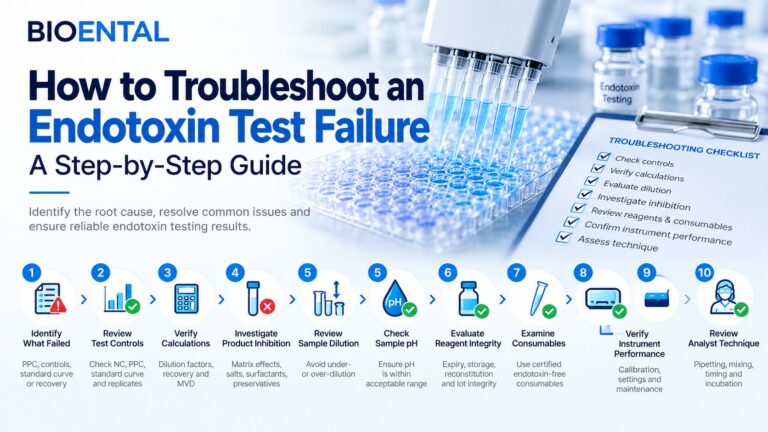
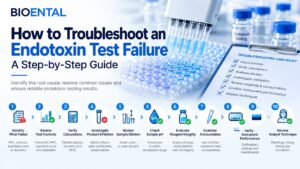
Step 1: Identify What Failed
Before troubleshooting, determine which part of the assay failed.
Common endotoxin testing failures include:
- Product Positive Control (PPC) failure
- Recovery below acceptance criteria
- Positive Negative Control (NC)
- Standard curve failure
- Invalid control results
- Unexpected endotoxin results
- Method suitability failure
Understanding the failure type significantly narrows the investigation.
Step 2: Review the Test Controls
Controls provide valuable clues regarding the source of failure.
Verify:
- Negative Control (NC)
- Positive Product Control (PPC)
- Standard Curve
- Endotoxin Standard Preparation
- Replicate Agreement
Questions to ask:
- Did the negative control remain negative?
- Did the PPC meet acceptance criteria?
- Was the standard curve valid?
- Were there outlier replicates?
Step 3: Verify Calculations
Many failures originate from simple calculation errors.
Review:
- Sample dilution factors
- Endotoxin spike concentration
- Recovery calculations
- Maximum Valid Dilution (MVD)
- Reagent reconstitution calculations
A second independent review is often beneficial.
Step 4: Investigate Product Inhibition
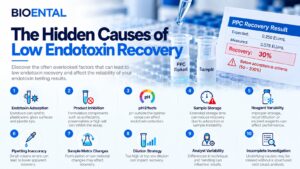
Product inhibition is among the most common causes of endotoxin testing failures.
Potential inhibitors include:
- High salt concentrations
- Chelating agents
- Surfactants
- Preservatives
- Organic solvents
- Certain proteins and biologics
Signs of inhibition include:
- PPC failure
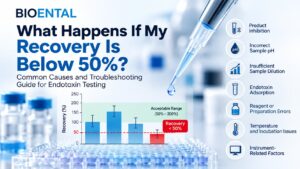
- Recovery below 50%
- Inconsistent recovery across dilutions
Step 5: Review Sample Dilution Strategy
Improper dilution can create two problems:
Under-Dilution
Inhibitory substances remain present and suppress endotoxin detection.
Over-Dilution
Endotoxin concentrations may fall below the assay’s detection capability.
Verify that testing remains within the validated Maximum Valid Dilution.
Step 6: Check Sample pH
Extreme pH conditions can interfere with endotoxin detection.
Review:
- Sample pH
- Buffer composition
- Sample preparation procedures
Correcting pH may improve recovery during method suitability studies.
Step 7: Evaluate Reagent Integrity
Reagent-related issues can produce unexpected results.
Confirm:
- Expiration dates
- Storage conditions
- Reconstitution procedures
- Freeze-thaw history
- Lot integrity
Always follow the manufacturer’s instructions.
Step 8: Examine Consumables
Endotoxin contamination or adsorption may occur when inappropriate consumables are used.
Review:
- Pipette tips
- Tubes
- Microplates
- Sample containers
Use certified endotoxin-free consumables whenever possible.
Step 9: Verify Instrument Performance
For kinetic and recombinant assays, instrument issues can contribute to failures.
Check:
- Reader calibration
- Software settings
- Temperature verification
- Maintenance records
Even minor instrument deviations may affect assay performance.
Step 10: Review Analyst Technique
Operator-related factors should not be overlooked.
Potential issues include:
- Pipetting inaccuracies
- Insufficient mixing
- Timing inconsistencies
- Incorrect incubation procedures
Regular competency assessments can reduce variability.
Common Failure Scenarios
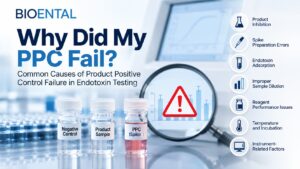
PPC Failure
Most commonly associated with:
- Product inhibition
- Incorrect spike preparation
- Calculation errors
Recovery Below 50%
Most commonly associated with:
- Sample interference
- Insufficient dilution
- Extreme pH conditions
Positive Negative Control
Most commonly associated with:
- Environmental contamination
- Contaminated consumables
- Poor aseptic handling
Standard Curve Failure
Most commonly associated with:
- Improper standard preparation
- Reagent issues
- Instrument performance problems
Troubleshooting Checklist
When an endotoxin test fails:
✓ Review controls
✓ Verify calculations
✓ Confirm dilution factors
✓ Evaluate product inhibition
✓ Check pH
✓ Review reagent integrity
✓ Verify consumables
✓ Confirm instrument performance
✓ Assess analyst technique
✓ Document findings and corrective actions
Preventing Future Failures
Laboratories can reduce repeat failures by:
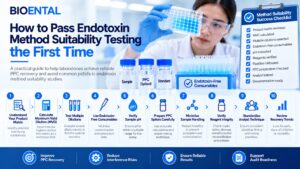
- Performing thorough method suitability studies
- Using certified endotoxin-free consumables
- Following validated procedures
- Maintaining calibrated equipment
- Training personnel regularly
- Establishing robust investigation procedures
Preventive measures are often more cost-effective than repeated investigations.
Conclusion
Most endotoxin test failures can be traced to a small number of root causes, including product inhibition, dilution errors, reagent issues, consumable contamination, and procedural deviations.
A structured troubleshooting process helps laboratories identify the source of failure, improve assay reliability, and maintain compliance with pharmacopeial and quality requirements.
BIOENTAL supports laboratories with endotoxin troubleshooting, method suitability studies, recombinant endotoxin technologies, technical consultation, and endotoxin-free consumables to help achieve reliable and compliant BET results.