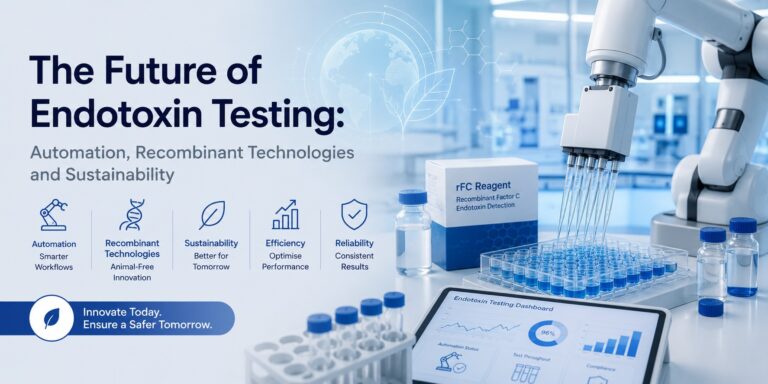
The Future of Endotoxin Testing: Automation, Recombinant Technologies and Sustainability
Introduction
Bacterial Endotoxin Testing (BET) has long been a critical component of pharmaceutical quality control. As the pharmaceutical, biotechnology and medical device industries continue to evolve, laboratories are under increasing pressure to improve efficiency, maintain compliance and support sustainability initiatives.
Emerging technologies are transforming how laboratories approach endotoxin testing. From automation and digitalisation to recombinant testing technologies such as Recombinant Factor C (rFC) and Recombinant Cascade Reagent (rCR), the future of endotoxin testing is becoming more efficient, more sustainable and increasingly data-driven.
This article explores key trends that are shaping the future of endotoxin testing laboratories.
Why Endotoxin Testing Continues to Evolve
Historically, endotoxin testing workflows have focused on ensuring product safety and regulatory compliance.
Today, laboratories face additional challenges, including:
-
- Increasing testing volumes
-
- Greater regulatory scrutiny
-
- Data integrity requirements
-
- Sustainability objectives
-
- Pressure to improve operational efficiency
These challenges are driving the adoption of new technologies and workflow improvements.
Trend 1: Increased Adoption of Recombinant Technologies
One of the most significant developments in recent years is the growth of recombinant endotoxin testing technologies.
Examples include:
Recombinant Factor C (rFC)
An animal-free technology that utilises a recombinant version of Factor C, the endotoxin-sensitive protein responsible for endotoxin detection.
Recombinant Cascade Reagent (rCR)
A newer generation recombinant technology that reproduces the complete endotoxin detection cascade while remaining entirely animal-free.
Benefits of Recombinant Technologies
-
- Animal-free testing
-
- Consistent reagent production
-
- Reduced dependence on biological sourcing
-
- Support for sustainability initiatives
-
- Long-term supply chain resilience
As awareness and acceptance continue to increase, many laboratories are evaluating recombinant technologies as part of their future testing strategy.
Trend 2: Laboratory Automation
Automation is becoming increasingly important within quality control laboratories.
Areas where automation can improve operations include:
-
- Sample preparation
-
- Data collection
-
- Result analysis
-
- Reporting
-
- Workflow management
Potential benefits include:
-
- Reduced manual intervention
-
- Lower risk of human error
-
- Improved productivity
-
- Faster turnaround times
Laboratories adopting automation are often better positioned to manage increasing testing demands.
Trend 3: Digitalisation and Data Integrity
Regulatory agencies continue to place strong emphasis on data integrity.
Modern laboratories are increasingly implementing:
-
- Electronic records
-
- Audit trails
-
- Laboratory Information Management Systems (LIMS)
-
- Automated reporting tools
-
- Digital workflow controls
These technologies help improve traceability, compliance and operational efficiency.
Trend 4: Greater Focus on Sustainability
Environmental, Social and Governance (ESG) initiatives are influencing decision-making throughout the pharmaceutical industry.
Laboratories are increasingly evaluating:
-
- Animal-free testing methods
-
- Reduced waste generation
-
- Efficient resource utilisation
-
- Sustainable supply chains
Recombinant endotoxin testing technologies have become an important part of many organisations’ sustainability discussions.
Trend 5: Workflow Standardisation
Laboratories are recognising that consistency often depends on more than just testing methods.
Increasing attention is being given to:
-
- Standardised procedures
-
- Endotoxin-critical consumables
-
- Operator training
-
- Sample handling practices
-
- Process optimisation
Reducing workflow variability can improve testing consistency and reduce troubleshooting efforts.
The Continued Importance of Consumables
Regardless of the testing technology used, consumables remain a critical component of endotoxin testing workflows.
Examples include:
-
- Endotoxin-free tubes
-
- Pyrogen-free pipette tips
-
- BET water
-
- Sample containers
-
- Reaction vessels
As testing technologies evolve, laboratories will continue to require reliable consumables that support consistent performance.
What Laboratories Should Consider Today
Laboratories do not necessarily need to implement every new technology immediately.
Instead, organisations may benefit from evaluating:
-
- Current workflow performance
-
- Future testing requirements
-
- Sustainability goals
-
- Regulatory expectations
-
- Technology readiness
A structured approach can help laboratories identify opportunities for improvement while maintaining compliance.
How BIOENTAL Supports the Future of Endotoxin Testing
BIOENTAL supports pharmaceutical, biotechnology and microbiology laboratories through:
-
- Endotoxin testing consumables
-
- Technical consultation
-
- Workflow optimisation
-
- Validation support
-
- Support for recombinant endotoxin testing technologies
We work with laboratories to identify practical solutions that support both current requirements and future operational goals.
Conclusion
The future of endotoxin testing is being shaped by automation, recombinant technologies, digitalisation and sustainability initiatives.
While patient safety and regulatory compliance remain the foundation of BET programmes, laboratories are increasingly exploring innovative approaches to improve efficiency, consistency and long-term resilience.
By understanding emerging trends today, laboratories can better prepare for the evolving demands of tomorrow’s pharmaceutical and life sciences industries.
Contact BIOENTAL
Have a question or need assistance? Our team is here to help. Feel free to reach out anytime.
Continue Learning
Recommended guides, troubleshooting resources, and validation insights for pharmaceutical, biotechnology, and medical device laboratories.