What Happens If My Endotoxin Recovery Is Below 50%?
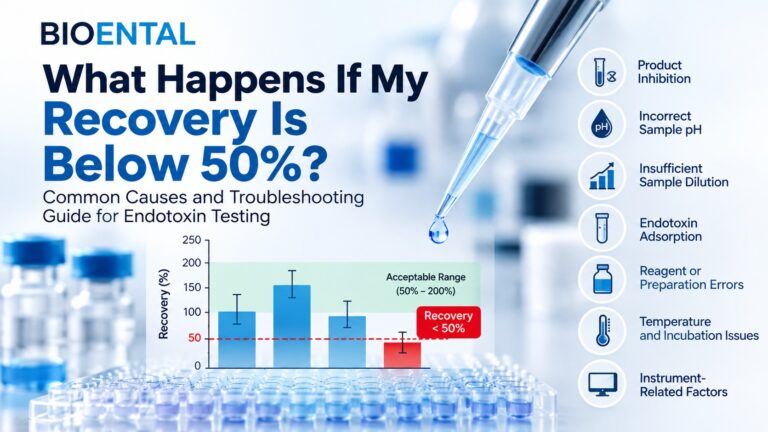
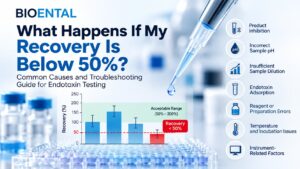
One of the most common issues encountered during bacterial endotoxin testing (BET) is obtaining an endotoxin recovery result below 50% during Product Positive Control (PPC) or method suitability testing.
When recovery falls below the acceptable limit, it may indicate that the sample matrix is interfering with the assay’s ability to detect endotoxin accurately.
Understanding the cause of low recovery is essential before proceeding with routine testing or releasing product.
What Does Recovery Below 50% Mean?
In quantitative endotoxin testing methods such as:
- Kinetic Chromogenic
- Kinetic Turbidimetric
- Recombinant Factor C (rFC)
a known amount of endotoxin is added to the sample.
The assay then measures how much of that endotoxin can be recovered.
Most pharmacopeial guidelines require recovery to fall within:
50%–200%
For example:
| Expected Spike |
Measured Recovery |
Recovery % |
| 0.5 EU/mL |
0.45 EU/mL |
90% |
| 0.5 EU/mL |
0.30 EU/mL |
60% |
| 0.5 EU/mL |
0.20 EU/mL |
40% |
A recovery result below 50% suggests inhibition of the endotoxin detection reaction.
Why Is Recovery Below 50% Important?
Low recovery means the assay may not be capable of detecting endotoxin accurately in the product matrix.
This creates the risk of:
- False-negative results
- Undetected endotoxin contamination
- Invalid assay performance
- Regulatory non-compliance
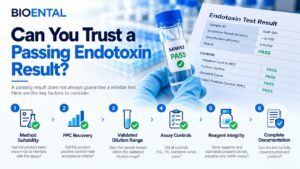
A passing PPC demonstrates that the assay can detect endotoxin in the presence of the sample.
A failing PPC means the test conditions may not yet be suitable.
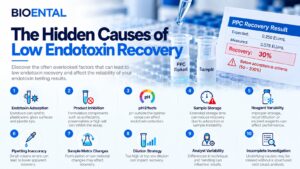
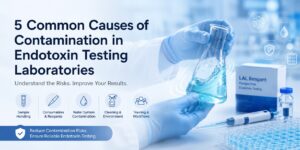
Common Causes of Recovery Below 50%
1. Product Inhibition
The most common cause of low recovery is inhibition from the sample itself.
Potential inhibitory substances include:
- High salt concentrations
- Preservatives
- Chelating agents
- Surfactants
- Organic solvents
- Certain protein formulations
These substances can interfere with the reaction cascade responsible for endotoxin detection.
2. Incorrect Sample pH
Extreme pH conditions can affect assay performance.
Recovery may decrease when the sample falls outside the validated pH range.
Always verify pH during method suitability studies.
3. Insufficient Sample Dilution
If inhibitory substances remain too concentrated, endotoxin recovery may be suppressed.
Increasing dilution is often one of the most effective troubleshooting approaches.
However, dilution must remain within the calculated Maximum Valid Dilution (MVD).
4. Endotoxin Adsorption
Endotoxin may bind to:
- Plastic surfaces
- Glass containers
- Pipette tips
- Non-certified consumables
This reduces the amount of endotoxin available for detection.
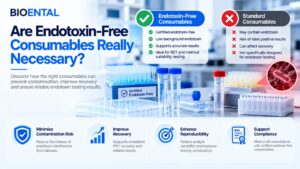
Using endotoxin-free consumables helps minimize this risk.
5. Reagent or Preparation Errors
Low recovery may result from:
- Incorrect endotoxin spike preparation
- Pipetting errors
- Improper mixing
- Expired reagents
- Incorrect reagent storage
Always verify preparation procedures before concluding that inhibition exists.
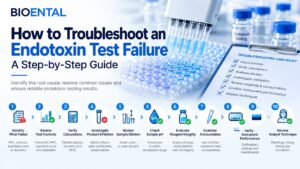
How to Troubleshoot Recovery Below 50%
Step 1: Verify Calculations
Review:
- Spike concentration
- Dilution factors
- Recovery calculations
- Endotoxin standard preparation
Calculation errors are more common than many laboratories realize.
Step 2: Increase Sample Dilution
Perform additional dilution studies while remaining below the MVD.
Common examples:
- 1:10
- 1:20
- 1:40
- 1:80
- 1:100
Many inhibitory effects diminish with dilution.
Step 3: Check Sample pH
Confirm that the sample falls within the validated assay range.
Adjust pH where permitted by the validated method.
Step 4: Evaluate Product Matrix Effects
Review product ingredients for known inhibitory substances such as:
- Detergents
- Chelators
- Antimicrobial preservatives
- Solvents
These may require additional method development work.
Step 5: Confirm Reagent Integrity
Verify:
- Expiry dates
- Storage temperatures
- Reconstitution procedures
- Instrument calibration status
Can I Report Results If Recovery Is Below 50%?
Generally, a PPC recovery below the validated acceptance criteria indicates that the assay conditions have not demonstrated suitability.
Laboratories should investigate and resolve the cause of low recovery before relying on the test result.
Acceptance criteria should always follow the applicable pharmacopeial requirements, validated procedures, and internal quality system requirements.
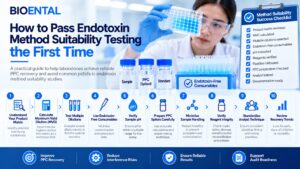
Preventing Low Recovery During Method Suitability Testing
Best practices include:
- Using certified endotoxin-free consumables
- Performing thorough method suitability studies
- Establishing validated dilution factors
- Monitoring sample pH
- Using properly stored reagents
- Following documented endotoxin handling procedures
These steps help ensure reliable endotoxin recovery and reduce repeat testing.
Conclusion
Recovery below 50% is often a sign that the sample matrix is interfering with endotoxin detection. Product inhibition, improper dilution, pH effects, adsorption, and preparation errors are among the most common causes.
A structured troubleshooting approach can help laboratories identify the root cause, establish suitable testing conditions, and ensure reliable endotoxin test results.
BIOENTAL supports pharmaceutical, biotechnology, medical device, and healthcare laboratories with endotoxin method suitability studies, troubleshooting support, recombinant endotoxin technologies, and endotoxin-free consumables to improve assay reliability and compliance.