Are Endotoxin-Free Consumables Really Necessary?
Many laboratories invest significant effort into selecting validated reagents, calibrating equipment, and training analysts for bacterial endotoxin testing (BET). However, one area that is often overlooked is the selection of consumables.
A common question is:
“Do we really need endotoxin-free consumables, or can we use standard laboratory supplies?”
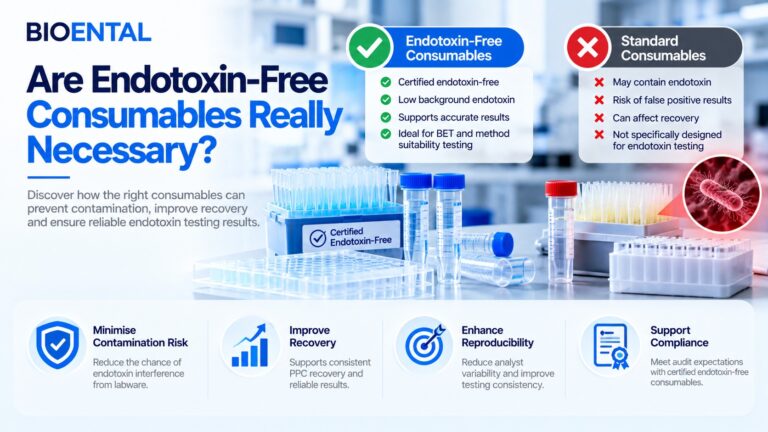
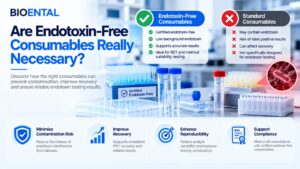
While standard laboratory consumables may appear clean, they are not necessarily free from endotoxins. The use of non-certified consumables can introduce contamination, affect endotoxin recovery, and contribute to invalid test results.
For laboratories performing endotoxin testing, endotoxin-free consumables are not simply a convenience—they are an important part of ensuring reliable and defensible results.
What Are Endotoxin-Free Consumables?
Endotoxin-free consumables are laboratory items that have been manufactured, processed, and tested to ensure endotoxin levels remain below specified limits.
Examples include:
- Pipette tips
- Microplates
- Sample tubes
- Reservoirs
- Bottles
- Vials
- Dilution tubes
- Syringes
These products are commonly supplied with certificates indicating compliance with endotoxin specifications.
Why Standard Laboratory Consumables May Be a Problem
Many standard laboratory consumables are designed for general laboratory use rather than endotoxin testing.
Although they may be sterile, sterility does not automatically mean endotoxin-free.
This is an important distinction because:
Sterile ≠ Endotoxin-Free
Sterilization processes eliminate microorganisms but may not remove endotoxins that remain after bacterial contamination.
As a result, a sterile consumable may still contain detectable endotoxin levels.
Risk #1: False Positive Results
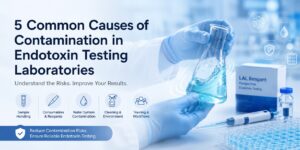
Perhaps the most obvious risk is endotoxin contamination originating from the consumable itself.
Potential sources include:
- Manufacturing residues
- Packaging contamination
- Environmental exposure
- Improper handling
When contamination is introduced by the consumable, laboratories may observe:
- Unexpected positive results
- Positive negative controls
- Investigation events
- Product release delays
Risk #2: Low Endotoxin Recovery
Contamination is not the only concern.
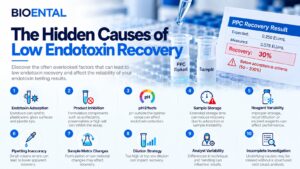
Certain materials can adsorb endotoxin molecules onto their surfaces.
This may reduce the amount of endotoxin available for detection.
Consequences may include:
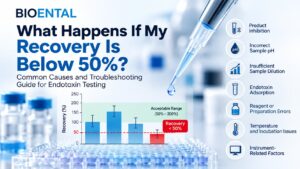
- Low PPC recovery
- Method suitability failures
- Variable recovery results
- Inconsistent assay performance
The issue is particularly important when testing samples containing low endotoxin concentrations.
Risk #3: Increased Analyst Variability
When consumables vary in quality, analysts may unknowingly obtain different results despite following the same procedure.
This can contribute to:
- Recovery fluctuations
- Investigation burden
- Reproducibility concerns
Standardizing consumables is one of the simplest ways to improve testing consistency.
Risk #4: Audit and Compliance Concerns
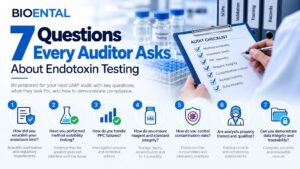
Auditors frequently review laboratory controls that support endotoxin testing reliability.
Questions may include:
- What consumables are used?
- Are they endotoxin-free?
- How are consumables qualified?
- Is supporting documentation available?
Using certified endotoxin-free consumables helps demonstrate a proactive contamination control strategy.
Which Consumables Should Be Endotoxin-Free?
Not every item in the laboratory requires endotoxin certification.
However, any item that directly contacts:
- Samples
- Standards
- Endotoxin spikes
- Reagents
should ideally be certified endotoxin-free.
Common examples include:
Pipette Tips
Used throughout sample preparation and dilution steps.
Sample Tubes
Frequently involved in dilution and recovery studies.
Microplates
Critical for kinetic chromogenic and recombinant assays.
Reservoirs
Used during sample transfer and reagent preparation.
Endotoxin-Free Water Containers
Prevent secondary contamination during preparation.
Are Endotoxin-Free Consumables Worth the Cost?
At first glance, endotoxin-free consumables may appear more expensive than standard laboratory supplies.
However, the true comparison should include the cost of:
- Failed PPCs
- Repeat testing
- Deviation investigations
- Product release delays
- Additional analyst time
- Audit observations
A single investigation often costs significantly more than the price difference between standard and endotoxin-free consumables.
For many laboratories, endotoxin-free consumables represent a relatively small investment that helps reduce much larger operational risks.
Common Misconceptions
“We’ve Never Had a Problem Before”
Endotoxin contamination can occur sporadically.
Past success does not guarantee future reliability.
“The Consumables Are Sterile”
Sterility alone does not confirm endotoxin-free status.
Endotoxin contamination may still be present.
“Only Reagents Affect Recovery”
Consumables can also influence recovery through adsorption and contamination.
“We Only Use Them for Transfers”
Even brief contact with samples can affect endotoxin testing outcomes.
Best Practices for Consumable Selection
Laboratories should consider:
✓ Certified endotoxin-free products
✓ Supplier quality documentation
✓ Lot traceability
✓ Consistent sourcing
✓ Proper storage conditions
✓ Qualification procedures
✓ Change control processes
Maintaining consistency helps reduce variability and improve confidence in test results.
What Do Auditors Expect?
During inspections, auditors often look for evidence that laboratories have considered contamination risks throughout the testing process.
Being able to demonstrate:
- Use of endotoxin-free consumables
- Supplier qualification
- Traceability records
- Risk assessments
helps strengthen the overall endotoxin testing program.
Conclusion
Endotoxin-free consumables play an important role in maintaining reliable bacterial endotoxin testing results. While standard laboratory consumables may appear suitable, they can introduce contamination risks, contribute to low recovery, increase variability, and create compliance concerns.
For laboratories seeking accurate, reproducible, and audit-ready endotoxin testing programs, the use of certified endotoxin-free consumables is often a practical and cost-effective control measure.
BIOENTAL supplies certified endotoxin-free consumables, method suitability support, technical troubleshooting, recombinant endotoxin testing solutions, and validation assistance to help laboratories achieve reliable and compliant BET results.