Endotoxin-Free Tubes: Why They Matter in Bacterial Endotoxin Testing
Introduction
Bacterial Endotoxin Testing (BET) is one of the most sensitive analytical procedures performed in pharmaceutical and microbiology laboratories. While significant attention is often given to testing methods such as Limulus Amebocyte Lysate (LAL), Recombinant Factor C (rFC) and Recombinant Cascade Reagent (rCR), the importance of laboratory consumables should not be overlooked.
One consumable that plays a critical role in endotoxin-sensitive workflows is the sample tube.
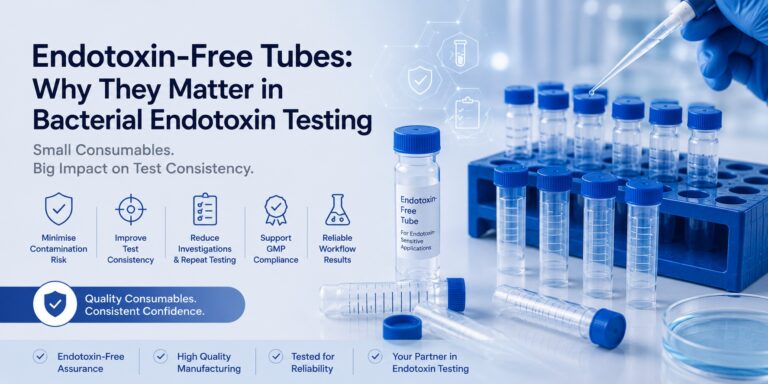
The use of suitable endotoxin-free tubes can help laboratories improve testing consistency, reduce contamination risks and minimise unnecessary investigations.
What Are Endotoxin-Free Tubes?
Endotoxin-free tubes are laboratory tubes manufactured and controlled to minimise endotoxin contamination.
These tubes are commonly used for:
-
- Sample collection
-
- Sample preparation
-
- Dilution procedures
-
- Reagent preparation
-
- Endotoxin testing workflows
Because endotoxins may be present on surfaces or introduced during manufacturing processes, not all laboratory tubes are suitable for endotoxin-sensitive applications.
Why Tube Selection Matters in BET
Bacterial endotoxin testing is designed to detect extremely low concentrations of endotoxins.
As a result, even small amounts of contamination introduced during sample preparation can potentially affect results.
Potential consequences include:
-
- Unexpected positive results
-
- Increased investigations
-
- Repeat testing
-
- Delayed product release
-
- Additional operational costs
While contamination may originate from multiple sources, laboratories often review consumables as part of troubleshooting activities.
Common Sources of Variability
Tube Manufacturing Differences
Different manufacturing processes and quality controls may result in varying levels of cleanliness and consistency.
Storage Conditions
Improper storage may increase the risk of contamination or affect product performance.
Handling Practices
Incorrect handling techniques can introduce contaminants even when suitable consumables are used.
Inconsistent Consumable Selection
Using multiple tube types across different workflows may introduce unnecessary variability.
Benefits of Using Endotoxin-Free Tubes
Laboratories may experience several benefits when using suitable endotoxin-critical consumables.
Improved Testing Consistency
Standardised consumables help reduce variability between testing runs.
Reduced Troubleshooting Efforts
Minimising contamination risks may reduce investigation and repeat testing requirements.
Greater Workflow Confidence
Quality-controlled consumables provide additional assurance during sample preparation and testing activities.
Support for GMP Compliance
Suitable consumables form part of an overall quality system designed to support reliable testing outcomes.
How to Select Endotoxin-Free Tubes
When evaluating tubes for endotoxin testing applications, laboratories may consider:
-
- Endotoxin specifications
-
- Manufacturing controls
-
- Product consistency
-
- Supplier reliability
-
- Technical support
-
- Compatibility with existing workflows
Selection should be aligned with the laboratory’s quality requirements and intended application.
Endotoxin-Free Tubes and Workflow Standardisation
Many laboratories are placing greater emphasis on workflow standardisation.
Areas commonly reviewed include:
-
- Endotoxin-free tubes
-
- Pyrogen-free pipette tips
-
- BET water
-
- Sample containers
-
- Sample handling procedures
Together, these elements can contribute to more reliable and reproducible testing outcomes.
How BIOENTAL Supports Endotoxin Testing Laboratories
BIOENTAL supports pharmaceutical, biotechnology and microbiology laboratories through:
-
- Endotoxin-free consumables
-
- Endotoxin-free tubes
-
- BET workflow consultation
-
- Technical support
-
- Validation assistance
We understand the importance of consumable quality in supporting reliable endotoxin testing programmes.
Conclusion
While testing methods often receive the most attention, suitable consumables remain a critical part of bacterial endotoxin testing workflows.
By selecting appropriate endotoxin-free tubes and standardising laboratory practices, organisations can reduce variability, minimise contamination risks and support more consistent testing outcomes.
For laboratories interested in evaluating endotoxin-free consumables, BIOENTAL would be pleased to support a discussion.
Contact BIOENTAL
Have a question or need assistance? Our team is here to help. Feel free to reach out anytime.
Continue Learning
Recommended guides, troubleshooting resources, and validation insights for pharmaceutical, biotechnology, and medical device laboratories.