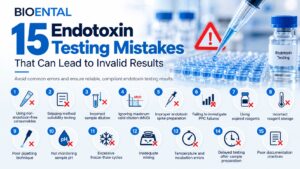
15 Endotoxin Testing Mistakes That Can Lead to Invalid Results
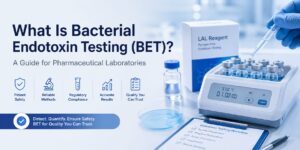
Bacterial Endotoxin Testing (BET) is a critical quality control procedure used throughout the pharmaceutical, biotechnology, medical device, and healthcare industries.
Even small procedural errors can lead to invalid results, failed Product Positive Controls (PPCs), repeat testing, investigation costs, and regulatory concerns.
Below are 15 common endotoxin testing mistakes and how laboratories can avoid them.
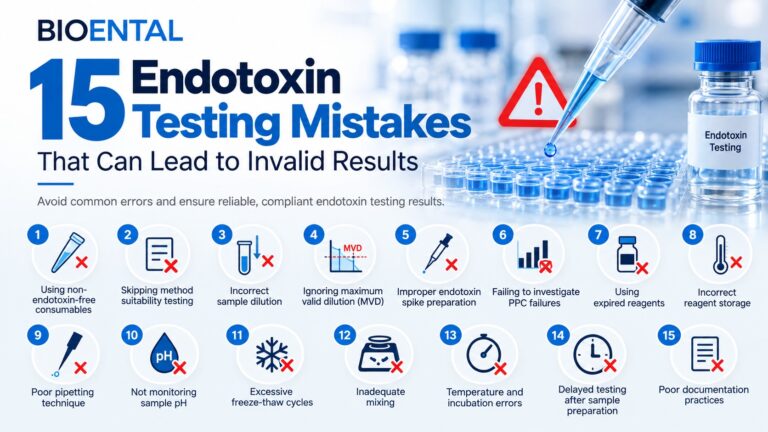
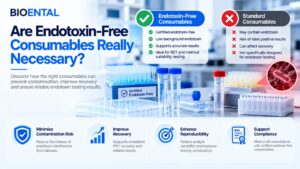
1. Using Non-Endotoxin-Free Consumables
Regular laboratory tubes, pipette tips, and microplates may introduce endotoxin contamination or adsorb endotoxin from samples.
Always use certified endotoxin-free consumables for BET applications.
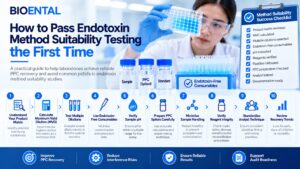
2. Skipping Method Suitability Testing
Every product matrix must demonstrate that it does not interfere with endotoxin detection.
Failure to perform method suitability testing can result in unreliable endotoxin results.
3. Incorrect Sample Dilution
Excessive dilution may reduce endotoxin concentrations below detectable levels.
Insufficient dilution may leave inhibitory substances present.
Both situations can compromise assay performance.
4. Ignoring Maximum Valid Dilution (MVD)
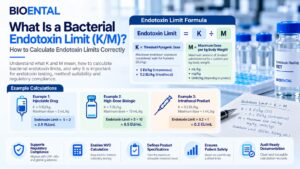
The MVD establishes the highest permissible sample dilution while maintaining assay sensitivity.
Testing beyond the MVD may invalidate results.
5. Improper Endotoxin Spike Preparation
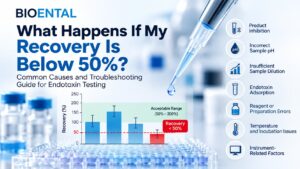
Calculation errors, inaccurate pipetting, or poor mixing can affect Product Positive Control recovery.
Always verify dilution calculations and preparation procedures.
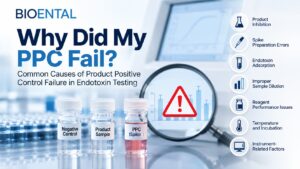
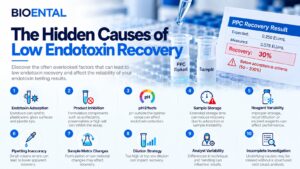
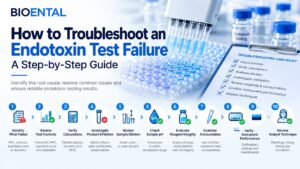
6. Failing to Investigate PPC Failures
A failed PPC often indicates assay interference.
Repeating the test without identifying the root cause may waste valuable time and resources.
7. Using Expired Reagents
Expired reagents may produce inconsistent results and increase assay variability.
Maintain a robust reagent inventory and monitoring system.
8. Incorrect Reagent Storage
Improper storage conditions may affect reagent performance.
Follow manufacturer recommendations regarding temperature and storage requirements.
9. Poor Pipetting Technique
Inaccurate pipetting can significantly affect recovery calculations and endotoxin concentrations.
Regular pipette calibration and operator training are essential.
10. Not Monitoring Sample pH
Extreme pH conditions can interfere with endotoxin detection reactions.
Verify pH requirements during method suitability studies.
11. Excessive Freeze-Thaw Cycles
Repeated freeze-thaw cycles may affect sample integrity and assay consistency.
Follow validated sample handling procedures.
12. Inadequate Mixing
Incomplete mixing can lead to uneven endotoxin distribution and inconsistent results.
Mix samples and endotoxin spikes thoroughly before analysis.
13. Temperature and Incubation Errors
Incorrect incubation temperatures or timing can affect assay performance.
Ensure equipment is properly calibrated and monitored.
14. Delayed Testing After Sample Preparation
Extended delays may increase the risk of adsorption or degradation effects.
Prepare and test samples according to validated procedures.
15. Poor Documentation Practices
Incomplete records can complicate investigations and regulatory audits.
Maintain clear and traceable laboratory documentation.
Best Practices to Avoid Endotoxin Testing Errors
Laboratories can reduce failures and repeat testing by:
- Using endotoxin-free consumables
- Performing method suitability studies
- Following validated procedures
- Monitoring reagent integrity
- Training laboratory personnel
- Verifying calculations and dilutions
- Maintaining calibrated equipment
A proactive quality approach helps ensure accurate and reproducible endotoxin results.
Conclusion
Most endotoxin testing failures can be traced back to a small number of preventable laboratory mistakes. Proper training, validated procedures, suitable consumables, and effective troubleshooting can significantly improve assay reliability and compliance.
BIOENTAL supports laboratories with endotoxin method suitability studies, technical troubleshooting, recombinant endotoxin technologies, and endotoxin-free consumables to help ensure accurate and compliant BET results.