What Is a Bacterial Endotoxin Limit (K/M)?
How to Calculate Endotoxin Limits Correctly
A bacterial endotoxin limit is the maximum allowable amount of endotoxin that may be present in a pharmaceutical product or medical device before it poses a potential risk to patient safety.
One of the most common questions asked during endotoxin method development, validation, and GMP audits is:
How do you calculate the bacterial endotoxin limit using the K/M formula?
Understanding the K/M formula is fundamental because it forms the basis for:
- Endotoxin specifications
- Method suitability studies
- Maximum Valid Dilution (MVD) calculations
- Regulatory compliance
- Product release testing
This guide explains what the K/M formula means, how endotoxin limits are calculated, and what auditors typically expect to see.
What Is a Bacterial Endotoxin Limit?
A bacterial endotoxin limit is the maximum amount of endotoxin permitted per unit of product.
The limit is established to ensure that patients are not exposed to unsafe levels of pyrogenic substances derived from Gram-negative bacteria.
Endotoxin limits are commonly applied to:
- Injectable drugs
- Biologics
- Cell and gene therapies
- Dialysis products
- Medical devices
- Water systems used in pharmaceutical manufacturing
The bacterial endotoxin limit is typically expressed as:
- EU/mL
- EU/mg
- EU/device
- EU/unit
depending on the product being tested.
What Does K/M Mean?
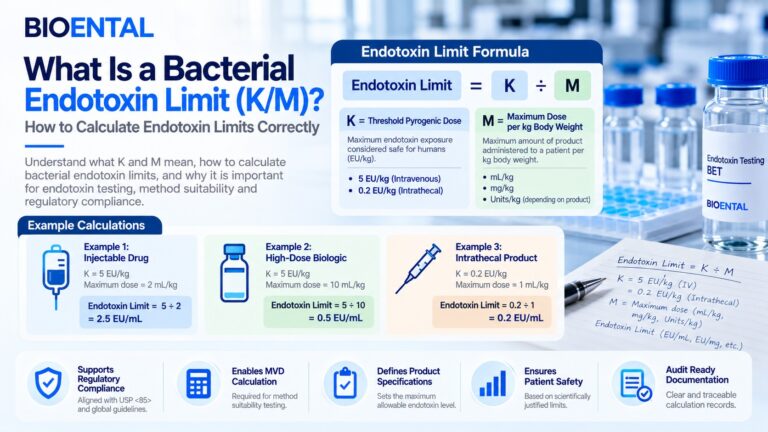
The bacterial endotoxin limit is calculated using:
K ÷ M
Where:
K = Threshold Pyrogenic Dose
K represents the maximum endotoxin exposure considered safe for humans.
Common pharmacopeial values include:
| Route of Administration |
K Value |
| Intravenous (IV) |
5 EU/kg |
| Intrathecal |
0.2 EU/kg |
These values are established by pharmacopeial authorities and regulatory guidance.
M = Maximum Dose Per Kilogram Body Weight
M represents the maximum amount of product administered to a patient per kilogram of body weight within a specified time period.
M must be scientifically justified and documented.
Examples may include:
- mL/kg
- mg/kg
- Units/kg
- Devices/kg
depending on the product type.
The Endotoxin Limit Formula
The formula is:
Endotoxin Limit = K ÷ M
This calculation determines the maximum allowable endotoxin concentration in the product.
Example 1: Injectable Drug
Assume:
- K = 5 EU/kg
- Maximum dose = 2 mL/kg
Calculation:
Endotoxin Limit = 5 ÷ 2
Endotoxin Limit = 2.5 EU/mL
The product specification would therefore be:
≤ 2.5 EU/mL
Example 2: High-Dose Biologic
Assume:
- K = 5 EU/kg
- Maximum dose = 10 mL/kg
Calculation:
Endotoxin Limit = 5 ÷ 10
Endotoxin Limit = 0.5 EU/mL
In this case, the larger patient dose results in a lower allowable endotoxin concentration.
Example 3: Intrathecal Product
Intrathecal products require a much stricter limit.
Assume:
- K = 0.2 EU/kg
- Maximum dose = 1 mL/kg
Calculation:
Endotoxin Limit = 0.2 ÷ 1
Endotoxin Limit = 0.2 EU/mL
This demonstrates why intrathecal products require highly sensitive endotoxin testing methods.
Why Is the Endotoxin Limit Important?
The endotoxin limit influences multiple aspects of bacterial endotoxin testing.
Method Suitability Testing
The limit is required when establishing suitable dilution conditions.
Maximum Valid Dilution (MVD)
MVD calculations cannot be performed without first determining the endotoxin limit.
The MVD formula is:
MVD = (Endotoxin Limit × Sample Concentration) ÷ λ
Where:
λ = labeled sensitivity of the endotoxin reagent.
Product Release Specifications
The endotoxin limit becomes part of the product’s release criteria.
Regulatory Compliance
Auditors routinely verify that endotoxin limits have been correctly established and documented.
Common Mistakes When Calculating Endotoxin Limits
Using the Wrong Maximum Dose
One of the most frequent errors is using a typical dose rather than the maximum possible patient dose.
Auditors generally expect the worst-case dose to be used.
Incorrect Unit Conversions
Calculation errors often occur when converting:
- mg to g
- mL to L
- patient dose to dose per kilogram
All calculations should be independently verified.
Using the Wrong K Value
Different administration routes have different K values.
Using the intravenous K value for an intrathecal product could result in a non-compliant endotoxin specification.
Failure to Document Assumptions
Auditors expect clear documentation supporting:
- Maximum dose selection
- Patient population assumptions
- Unit conversions
- Calculation methodology
What Do Auditors Ask About Endotoxin Limits?
During GMP inspections, auditors frequently ask:
How was the endotoxin limit established?
Which K value was used?
How was the maximum dose determined?
Can you show the calculation?
Is the calculation approved?
Has the limit been reassessed following formulation changes?
A laboratory should be able to provide clear and traceable supporting documentation.
Frequently Asked Questions (FAQ)
What is the K/M formula in endotoxin testing?
The K/M formula is used to calculate the bacterial endotoxin limit by dividing the threshold pyrogenic dose (K) by the maximum patient dose per kilogram body weight (M).
What is K in endotoxin limit calculations?
K is the maximum endotoxin exposure considered safe for humans and is typically 5 EU/kg for intravenous products and 0.2 EU/kg for intrathecal products.
What is M in endotoxin testing?
M represents the maximum amount of product administered to a patient per kilogram of body weight during a specified dosing period.
Why is the endotoxin limit important?
The endotoxin limit determines the product specification and is required for method suitability studies, MVD calculations, and regulatory compliance.
Does every product require an endotoxin limit calculation?
Products subject to bacterial endotoxin testing generally require a scientifically justified endotoxin limit.
Key Takeaways
- The bacterial endotoxin limit defines the maximum allowable endotoxin concentration in a product.
- The endotoxin limit is calculated using the K/M formula.
- K represents the threshold pyrogenic dose.
- M represents the maximum patient dose per kilogram body weight.
- Endotoxin limits form the basis for MVD calculations and method suitability studies.
- Incorrect endotoxin limit calculations can affect validation, product release, and regulatory compliance.
About BIOENTAL
BIOENTAL provides endotoxin testing solutions, method suitability studies, recombinant endotoxin technologies, endotoxin-free consumables, validation support, and technical consultation for pharmaceutical, biotechnology, medical device, healthcare, and research laboratories across Asia.
Conclusion
Understanding how to calculate bacterial endotoxin limits using the K/M formula is essential for developing compliant endotoxin testing programs. A properly justified endotoxin limit supports method suitability studies, MVD calculations, product release specifications, and audit readiness.
By establishing scientifically sound endotoxin limits and maintaining complete supporting documentation, laboratories can improve testing reliability and strengthen regulatory compliance.