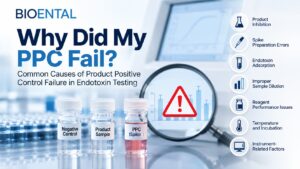
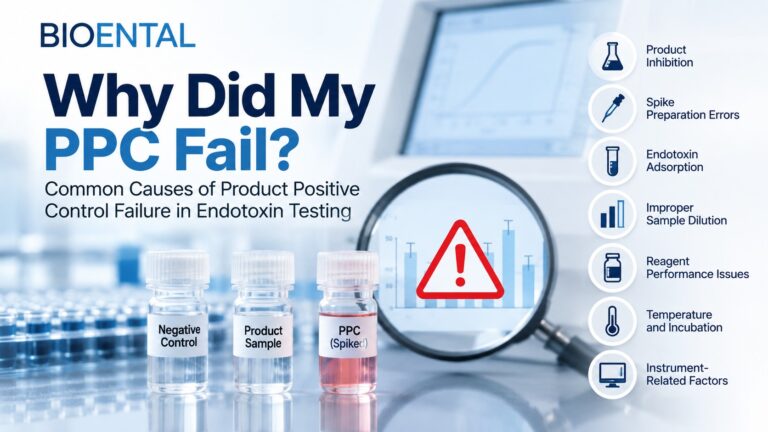
Why Did My PPC Fail? Common Causes of Product Positive Control Failure in Endotoxin Testing
In bacterial endotoxin testing (BET), a failed Product Positive Control (PPC) is one of the most common issues encountered during method suitability testing and routine analysis. A PPC failure indicates that the assay could not adequately recover the known endotoxin spike added to the sample, raising concerns about assay validity and potential interference.
Understanding the root cause is critical before reporting results or repeating the test.
What Is a PPC?
The Product Positive Control is prepared by spiking a known amount of endotoxin into the test sample matrix.
Its purpose is to verify that the sample does not inhibit or enhance the endotoxin detection reaction.
For a valid assay:
-
- Gel Clot: Positive clot formation must occur.
-
- Kinetic Chromogenic/Turbidimetric: Recovery typically falls within 50%–200%.
-
- Recombinant Factor C (rFC): Recovery requirements follow the applicable pharmacopeial or validated method criteria.
Failure indicates that the sample matrix may be interfering with endotoxin detection.
1. Product Inhibition
Product inhibition is the most common cause of PPC failure.
Certain sample components can interfere with the enzymatic cascade responsible for endotoxin detection.
Common inhibitory substances include:
-
- High salt concentrations
-
- Extreme pH conditions
-
- Chelating agents (e.g., EDTA)
-
- Surfactants and detergents
-
- Organic solvents
-
- Preservatives
-
- Certain protein formulations
When inhibition occurs, the assay may not detect the spiked endotoxin even though it is present.
Potential Solutions
-
- Increase sample dilution while remaining below the Maximum Valid Dilution (MVD).
-
- Adjust pH to the validated range.
-
- Perform method suitability studies to determine acceptable dilution factors.
- Consider alternative endotoxin detection technologies if interference persists.
2. Incorrect Endotoxin Spike Preparation
Errors during PPC preparation can lead to apparent recovery failures.
Common mistakes include:
-
- Incorrect reconstitution of Control Standard Endotoxin (CSE)
-
- Calculation errors during dilution
-
- Improper mixing after spiking
-
- Pipetting inaccuracies
-
- Use of expired standards
Even small preparation errors can significantly affect recovery calculations.
Potential Solutions
-
- Use calibrated pipettes.
-
- Follow documented dilution procedures.
-
- Vortex or mix thoroughly after spiking.
-
- Verify calculations independently.
- Prepare fresh endotoxin dilutions when required.
3. Endotoxin Adsorption to Surfaces
Endotoxin molecules can adsorb onto laboratory surfaces, reducing the amount available for detection.
Adsorption may occur on:
-
- Standard plastic tubes
-
- Pipette tips
-
- Glass containers
-
- Non-certified laboratory consumables
This issue becomes more significant when working with low endotoxin concentrations.
Potential Solutions
-
- Use endotoxin-free certified consumables.
-
- Minimize unnecessary transfer steps.
-
- Prepare fresh dilutions immediately before use.
- Follow validated handling procedures.
4. Improper Sample Dilution
Excessive dilution may reduce the endotoxin spike below detectable levels.
Insufficient dilution may leave inhibitory substances present.
Both scenarios can produce PPC failures.
Potential Solutions
-
- Confirm dilution calculations.
-
- Verify compliance with MVD requirements.
- Establish validated dilution factors during method suitability testing.
5. Reagent Performance Issues
PPC failures can occasionally arise from reagent-related problems.
Potential causes include:
-
- Improper reagent storage
-
- Expired reagents
-
- Repeated freeze-thaw cycles
-
- Incorrect reconstitution
-
- Contamination during preparation
Potential Solutions
-
- Store reagents according to manufacturer instructions.
-
- Monitor expiration dates.
-
- Use freshly prepared reagents where required.
- Maintain proper laboratory handling practices.
6. Temperature and Incubation Problems
The endotoxin reaction is sensitive to environmental conditions.
Potential issues include:
-
- Incorrect incubation temperature
-
- Uneven heating
-
- Premature reading of results
-
- Extended incubation beyond validated conditions
Potential Solutions
-
- Verify incubator performance regularly.
-
- Follow the validated test procedure precisely.
- Monitor environmental conditions during testing.
7. Instrument-Related Factors
For kinetic and recombinant technologies, instrument issues can affect PPC recovery.
Examples include:
-
- Incorrect reader settings
-
- Calibration drift
-
- Optical interference
-
- Software configuration errors
Potential Solutions
-
- Perform routine instrument calibration.
-
- Verify assay settings before each run.
-
- Follow manufacturer maintenance recommendations.
Troubleshooting Workflow
When a PPC fails:
-
- Review dilution calculations.
-
- Confirm endotoxin spike preparation.
-
- Verify reagent integrity and storage conditions.
-
- Check sample pH and composition.
-
- Evaluate potential product inhibition.
-
- Review instrument and incubation conditions.
-
- Repeat testing only after identifying and addressing the likely root cause.
Repeating a failed PPC without investigation may not resolve the underlying issue.
Conclusion
A failed PPC does not automatically indicate assay failure or contamination. More commonly, it signals interference within the sample matrix, procedural errors, or reagent-related issues.
Systematic troubleshooting can help laboratories identify the root cause, establish suitable testing conditions, and maintain compliance with pharmacopeial endotoxin testing requirements.
At BIOENTAL, we support laboratories with endotoxin method suitability studies, troubleshooting assistance, validation strategies, recombinant endotoxin technologies, and endotoxin-free consumables to help achieve reliable and reproducible BET results.
Continue Learning
Recommended guides, troubleshooting resources, and validation insights for pharmaceutical, biotechnology, and medical device laboratories.